

Most senior leaders believe they’re spending time on their priorities. Their calendars tell a different story.
An executive is busy. Visibly, demonstrably busy - back-to-back meetings, a inbox that never empties, a schedule so compressed that thinking time has been reserved solely for bathroom breaks. And yet the strategic priorities aren’t moving. The decisions that matter keep getting deferred. The work that would actually change the trajectory of the business sits in a holding pen.

Everyone around the executive can see it. The executive often cannot - because the experience of being busy and the experience of being effective feel almost identical from the inside. She “can’t see the wood for the trees” comes to mind.
This is not a time management problem. It is a visibility problem with a straightforward solution that most organisations never think to use: a systematic audit of how executive time is actually being spent, conducted by the person who has the clearest view of it.
That person is almost always the EA.
Why calendars lie by omission
A calendar is not a record of how time is spent. It is a record of commitments made - often weeks or months in advance, under different circumstances, with different priorities in play. By the time those commitments arrive in the present week, they may bear little relationship to what is important now.
This gap between the calendar as planned and the calendar as lived is where most organisations lose significant executive capacity. A recurring meeting that was useful eighteen months ago persists because nobody thought to question it. A stakeholder relationship gets three hours a week not because it warrants three hours, but because that is how the relationship was originally structured and inertia is powerful. Travel, prep time, and administrative overhead accumulate in the diary without anyone deciding that this is the best use of the most expensive time in the organisation.
The result is an executive who is genuinely fully committed - and genuinely under-invested in the work that would create the most value.
Research consistently bears this out. A study by Bain & Company found that in a typical large organisation, senior leaders spend less than 20% of their time on activities directly connected to their organisation’s stated strategic priorities. The remainder is consumed by operational maintenance, reactive demands, and the accumulated weight of commitments that were never designed around a coherent view of where the executive’s time should go.
The calendar, in other words, is not a neutral document. It is a record of every compromise, every inherited obligation, every relationship demand, and every urgent thing that displaced an important one. Reading it clearly - without the filter of good intentions or the noise of busyness - requires a particular kind of discipline.
The audit in practice
The diary audit is built on a simple premise: before you can change how time is spent, you need an honest picture of how it is currently spent. Not an estimated picture, not an aspirational one - an accurate one.
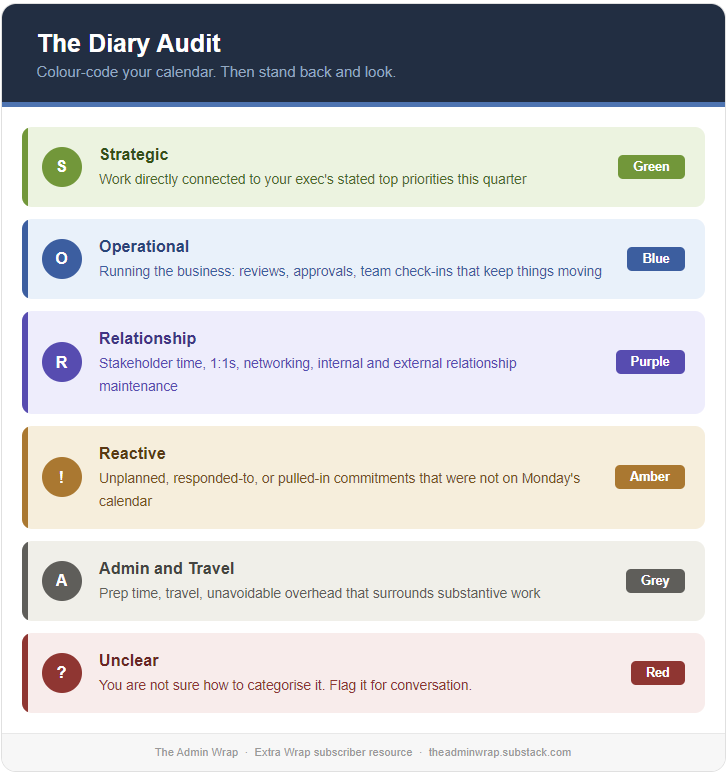
The method is straightforward. Every item on the calendar for a given week is assigned to one of six categories:
Strategic - work that directly advances the executive’s stated top priorities for the quarter. Not loosely related. Directly connected.
Operational - the work of running the business. Team meetings, pipeline reviews, approval processes, the mechanisms that keep the organisation functioning. Necessary, but not where growth comes from.
Relationship - internal and external relationship maintenance. Stakeholder engagement, one-to-ones, networking. Often valuable, but frequently over-weighted relative to its actual contribution.
Reactive - unplanned or responded-to commitments. The meeting that landed in the diary at short notice. The crisis that required immediate attention. The conversation that expanded beyond its intended scope.
Admin and travel - preparation time, transit, the overhead that surrounds substantive work but is not itself substantive.
Unclear - items that resist easy categorisation, or whose purpose is not immediately apparent. These warrant a conversation of their own. Where should they sit?
The categorisation exercise itself takes twenty to thirty minutes for a typical executive week. But the insight it generates is disproportionate to the effort, because what emerges is not a list of meetings - it is a portrait of where organisational attention is actually going.
Most EAs who complete this exercise for the first time report the same reaction: the gap between what the executive says their priorities are and what the calendar shows is larger than either of them had realised.
The visual as diagnostic tool
Rather than building a spreadsheet or producing a detailed analysis, this diary audit uses the calendar’s own visual language to make the pattern visible.
Most major calendar platforms - Google Calendar, Microsoft Outlook, Apple Calendar - allow individual events to be colour-coded. Assign a colour to each of the six categories, apply it consistently, and step back. The week view, with its colour-coded column of events, becomes an immediate diagnostic. You do not need to count anything. You do not need to calculate percentages. You simply look.
A week that is predominantly green and blue - strategic and operational - is broadly healthy. A week that is saturated in amber and grey - reactive commitments and administrative overhead - is a week in which the executive has been, in effect, working for the diary rather than the other way around. A week with almost no green at all is a week in which the stated priorities received almost no direct attention, regardless of how full the schedule appeared.
The power of the visual is that it bypasses the rationalisation that almost always accompanies a verbal discussion of time use. It is very easy for an executive to explain, item by item, why each commitment was necessary. It is much harder to look at a week that is predominantly amber and grey and argue that the balance is right.
The colour-coded calendar does not make an argument. It simply shows what is there.
The gap that matters most
The audit becomes fully useful only when it is held against a baseline of your executive’s stated priorities.

This is the step most EAs skip, and it is the most consequential one. Before opening the calendar, write down - from memory, or from a recent conversation - what your executive has described as their top priorities for the quarter. Five things, as specifically as possible. Not broad themes. Actual commitments: the market they intend to develop, the operational problem they have committed to fixing, the relationship they have said they need to invest in.
Then look at the calendar.
The question is not whether the executive has been busy. The question is how much of the green - the genuinely strategic time - is directly connected to those specific five things. In most cases, the answer is uncomfortable. Some priorities have significant calendar representation. Others, which the executive would describe as equally important, have almost none. The distribution of attention rarely matches the stated distribution of priority.
This gap is not evidence of bad intent. It is evidence of the way organisations actually work: urgent things displace important ones, inherited commitments crowd out new directions, and the path of least resistance through a week produces a calendar that reflects momentum rather than strategy.
Seeing the gap is the first step to closing it.
Turning the audit into a conversation
